
The chemistry between the motley bunch of actors works in fits and starts but Akshay Kumar's gift of the gab, Taapsee's bumbling comedienne and Fardeen Khan's dry wit come out tops, notes Sukanya Verma.

The universe of stocks trading at a 12-month forward price-to-earnings (P/E) multiple of 50x or more has swelled by 2.5x to 104, indicating the growing froth in the market. In March 2023, the number of stocks with a P/E of 50x and 100x stood at 41 and 3, respectively, which has now grown to 104 and 9, according to an analysis by Kotak Institutional Equities (KIE).

'Sectors like e-commerce, small finance, housing finance, and healthcare are in great favour, and people are paying a PEG ratio of up to 5, which is dangerous.' 'Wealth destruction is inevitable.'

Larger listed domestic-focused tyre companies have underperformed the benchmarks in the last three months but exporter Balkrishna Industries has bucked the trend. The company, which exports off-highway tyres, has generated 43 per cent returns in this time compared to MRF and Apollo Tyres, which are down 5-10 per cent. In addition to better-than-expected performance in the March quarter, exports and market share gains have helped Balkrishna pull ahead of peers.

The recent weakness of the rupee has been due to yuan's devaluation.

The recent blip in housing sales on a quarter-on-quarter (Q-o-Q) basis should not worry investors as the long-term prospects of real estate stocks remain on a strong foundation, according to analysts. In the first half of the calendar year 2024 (H1CY24), realty stocks surged up to 104 per cent. This sharp run should be used to book partial profit in related stocks, suggested Deepak Jasani, head of retail research at HDFC Securities.

'Despite the current uncertainties, the long-term outlook remains constructive due to strong fundamentals, government initiatives, and a stable banking sector.'
The Reserve Bank of India on Friday raised the benchmark lending rate by 50 basis points to 5.40 per cent to tame inflation.

Truck movements across the India-Bangladesh border are on the rise, with increasing rentals signalling a trade recovery between the two South Asian nations. Yet, geopolitical tension looms large, with Bangladesh now under an interim government for nearly two months.

'Over the next 12 months, it will be difficult to make 15 to 20 per cent return in the markets as the valuations appear stretched.'

Divya Deshmukh of India outclassed Bulgaria's Beloslava Krasteva to clinch the title in the World Junior Girls' chess championship

Among the Sensex constituents, 20 stocks ended the session in green with HDFC Bank, Titan, Tech Mahindra, and Asian Paints being the major gainers. TCS, Maruti, Kotak Mahindra Bank and Bajaj Finserve were the other gainers. In contrast, SBI, Bharti Airtel, JSW Steel, PowerGrid, ITC and Reliance closed the trading with losses.

Equities went into a tailspin on Wednesday after the Reserve Bank surprised the market with a mid-cycle rate hike in a bid to tame soaring inflation.

'India's fundamentals are a lot better (than those of other emerging market economies).' 'India will suffer (witness a fall in its stock market) what I call the second order effect.' 'And the second order will happen when these funds (belonging to macro and hedge fund investors and which have leveraged Japanese yen-carry trades), because they lose money elsewhere as lot of their positions were financed by borrowing Japanese yen, will have to book profits in investment destinations where they are making money, including in markets like India.' 'They (these investors) will have to effectively sell in countries like India and which is the consequence (the crash in equity markets) that Indian markets might see.'

No immediate comment was available from airlines on the impact of the price hike on passenger fares.

'What do the moves towards protectionism suggest?' 'That we do not have Aatmavishwas.' 'If you have self-confidence, confidence in your ability to compete with the best in the world, why do you need protectionism?'

Once we break free of the idea that land is scarce, real estate is just a pile of bricks, steel, and glass. Any price surge will kick off a supply response, which kills off the possibility of sustained price appreciation, points out Ajay Shah.

Petroleum and oil marketing companies raised the price of commercial liquid petroleum gas (LPG) cylinders by Rs 350.50 per unit and domestic LPG cylinders by Rs 50 per unit with immediate effect from Wednesday.

'The structural story of India is a multi-decadal story.' 'One should stay invested in that story and avoid reacting to what is happening globally.'

'By investing in a basket of funds, FoFs can help minimise the impact of underperforming funds, thus reducing overall investment risk.'

From the Sensex pack, Tata Steel, Titan, Tech Mahindra, Wipro, Bajaj Finserv, Bajaj Finance, Nestle India, Tata Motors and JSW Steel were the biggest laggards. ICICI Bank, Axis Bank, HDFC Bank, State Bank of India and Kotak Mahindra Bank were the gainers.

From the Sensex pack, Tata Motors slumped over 7 per cent. Adani Ports, Tata Steel, SBI, Power Grid, JSW Steel and Maruti were the other big laggards. However, Hindustan Unilever and Nestle ended in positive territory.

Profits of India's top listed companies have been growing at a faster pace than those of their American peers, but when it comes to revenue growth, the order has reversed recently. The combined net profit of the S&P 500 companies was up 14.1 per cent year-on-year (Y-o-Y) during the trailing 12 months (TTM) ended December 2023, as against 17.4 per cent profit growth logged by the BSE 500 companies in the same period. This is the second consecutive year of faster profit growth for the BSE 500 companies.
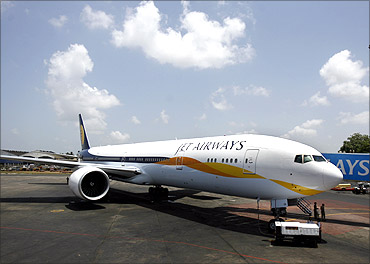
Jet fuel (ATF) rates were on slashed by a steep 12.5 per cent, the sixth straight reduction in prices since August, as international oil prices slumped to five-year low levels.

From the Sensex pack, HCL Technologies, Infosys, Wipro, Bharti Airtel, Larsen & Toubro, Mahindra & Mahindra, Tata Consultancy Services and Asian Paints were the major gainers. Axis Bank, IndusInd Bank, Bajaj Finance, JSW Steel, State Bank of India and Tata Steel were among the major laggards.

The fall in total reserves was mainly because of a decline in foreign currency assets worth $4.5 billion, the data showed.

India's finance minister has emphasised that "it is the real economy that is going to matter.
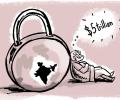
The wait for India to become a $5-trillion economic powerhouse by 2024-25 (FY25) is going to take longer than what the finance ministry had originally intended, according to the International Monetary Fund (IMF). The vision will instead be achieved in 2028-29 (FY29), reveals the IMF data, illustrating a four-year delay. Chief Economic Advisor (CEA) V Anantha Nageswaran had in February said India would become a $5-trillion economy by 2025-26 or the following year, on the back of 8-9 per cent sustained growth rate in real gross domestic product (GDP). However, the IMF data conveys that the economy will be $4.92 trillion in FY28, clearly alluding to the fact that the target will be realised in FY29.

'We can hope to see a lot of creation of jobs in the days to come.'

The two countries also signed a 'Memorandum of Agreement regarding the Assignment of Liaison Officers', which will facilitate the posting of one military officer from each country with the military of the other.

Tactical investors should have an investment horizon of around six months to one year, long-term investors should stick around for 10 years or more.

In a recent article, Rajan has ridiculed critics of the exchange rate policy.

Fresh meat and seafood delivery unicorn Licious is intensifying its talent acquisition endeavours as it pursues profitability and readies for an initial public offering (IPO) within the next 24 months. Delightful Gourmet, Licious' parent company, has named 39-year-old Karishma Gupta as its new chief financial officer (CFO). Her appointment aligns with Licious' drive for profitable growth through an omnichannel strategy.

Bajaj Auto, India's leading two-wheeler (2W) and three-wheeler (3W) maker, is scaling up its wholly owned finance subsidiary, Bajaj Auto Credit Ltd (BACL), with an investment of more than Rs 3,000 crore planned over the next two financial years, company's managing director Rajiv Bajaj said. BACL has already started commercial operations, Bajaj recently said on the sidelines of the group's CSR identity event. According to rating agency CRISIL, BACL's operations began on January 1 after receiving its licence from the Reserve Bank of India (RBI) in August last year.

From the Sensex basket, Tata Consultancy Services, Nestle, Bajaj Finserv, Wipro, Maruti Suzuki India, Reliance Industries, Larsen & Toubro and NTPC were the major laggards. Tata Steel, Bajaj Finance, JSW Steel and Bharti Airtel were among the gainers.

With the prediction of an above normal monsoon in 2024, the government is expecting food prices to come down, the finance ministry's monthly economic report for March has said. The report, released on Thursday, said robust foreign inflows and comfortable trade deficits were expected to keep the rupee within a comfortable range. "Further easing of food prices is on the anvil as IMD (India Meteorological Department) has predicted above-normal rainfall during the monsoon season, which is likely to lead to higher production, assuming good spatial and temporal distribution of the rainfall," the monthly report, released by the Department of Economic Affairs, said.

A combination of factors, including heavy investments in US Treasury bonds and dollar sales at a healthy profit, facilitated the Indian central bank in transferring a record surplus of Rs 2.11 trillion to the government for 2023-24 (FY24). The RBI's dollar purchases increased in FY24, supported by robust capital inflows endorsing the economy's health.
From the Sensex basket, Tata Steel jumped over 5 per cent. Mahindra & Mahindra, JSW Steel, Tata Motors, Axis Bank, Sun Pharma, Reliance Industries and Maruti were the other biggest gainers. Infosys, Tata Consultancy Services, Titan, Wipro, Hindustan Unilever and Nestle were among the laggards.

Average policy rate over the next three years should be around 7.4%
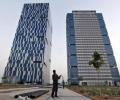
With the government clearing the decks for direct listing at the Gujarat International Finance Tec-City (GIFT City) International Financial Services Centre (IFSC), issuers will wait for the ecosystem to develop further before firming up their listing plans. In the meantime, most companies may continue to prefer listing in the onshore market, even as the new avenue provides key benefits such as tax waivers and reduced foreign exchange risk. Sources said that a few key things need to be ironed out further.
